Thursday, 13 November 2014

AUSTRALIA - Australian poverty rate hits 13.9 per cent, ACOSS report shows


An article by Lauren Wilson entitled „Australian poverty rate hits 13.9 per cent, ACOSS report shows“ published on the website news.com.au on 12th October 2014 discusses the reasons for the increasing poverty rate in Australia. Today, Australia has more than 2.5 Million inhabitants who live below the OECD poverty line. These 19.9% of the population live with less than 400$ per week if they are a single adult or with less than 841$ per week if they are a couple with two or more children. The executive chief of the Australian Council of Social Service (ACOSS) says the findings highlight the need for a national plan to tackle the problem of poverty. She also mentions that such a rise of the poverty rate is unacceptable. In addition, she emphasizes that the community has to be confronted with the problems if there should be any improvement.
According to the report, the worst situation is found in the island of Tasmania with 15% of people living in poverty. Directly behind lies Queensland, New South Wales, Victoria, Western Australia and last in line is South Australia with 11.7%. It is also mentioned that women are more in danger of living in poverty than men. We also learn that a half of all the recipient of welfare live below the poverty line set by the OECD.

What we have to say about this:

According to the statistics, Australia has had a continuum economic growth since 1992. In 2008 the national unemployment rate decreased to only 4 percent, which was the minimum for over 30 years. Australia has a well-developed education system, a good health system and in general people have a high standard of living, even though there are more than 2.5 million Australians out of 23 million inhabitants living below the OECD poverty line today. In the past two years the national poverty rate rose to 13.9 percent. For the Australian children the situation is even worse: 17.3 percent of kids across the island live in poverty and as far as single parent households are concerned more than one of three is poor. And the unemployment rate in Australia is about 6.4 percent in 2014. So what happened?

In 2009 the financial crisis hit Australia. More than 300’000 people lost their jobs and the unemployment rate rose to 5.59 percent.  In Switzerland the unemployment rate rose from 2.5 to 4.5 percent. After the financial crisis the rate decreased very fast in Switzerland and two years later was almost as low as before the crisis. On the island the rate only decreased to 5.3 percent and stayed constant in the following years. Since the beginning of the year the rate has risen and in July reached a rate of 6.3 percent, which is the highest in 12 years. More than 1.5 million Australians don’t have a job today.

Unfortunately there’s not a real system to support the unemployed in Australia. Compared to Switzerland the unemployment benefit is extremely low. With the budget of a welfare recipients a normal live is nearly impossible and for a lot of people it means living in poverty.

But the main reason for the rising unemployment rate and the increasing poverty rate is the high population growth. In 2013 the Australian population grew about 1.7 percent. 60 percent of the growth was due to immigration. The Swiss population grew in the past year about 1.1 percent and only grows because of immigration. A lot of people come to Australia to work there, but then can’t find a job. But not only immigrants are suffering because of the lack of job offers. Also teenagers between 15 and 24 years have problems finding a job. About 18 percent of them don’t have a job.

The Australian economy is growing and every year there will be new job offers but the problem is that the economy doesn’t grow as fast as would be required to satisfy the demand for new jobs, a demand caused by the growing population. And because there is no real system to support the unemployed a large part of the population lives in “poverty”. (Gr, Ma, Jo, Ni)


Monday, 10 November 2014

NEW ZEALAND - School absenteeism in Auckland horrifies police

According to an article by Sam Boyer entitled “School absenteeism in Auckland horrifies police” published on 25th September 2014 the police in New Zealand visited three different schools; the Manurewa high school, the James Cook High School and the Alfriston College. During their expedition they made a shocking discovery: Of the 4586 students that should have attended schools, 321 were absent! This corresponds to about seven percent of all students.

This generation of students doesn’t seem to fully understand the importance of education for their personal development and professional careers. They don’t take school seriously as they used to. The percentage of teenagers playing truant increases from year to year. In “The New Zealand Herald” it is written that only one year ago the percentage of the high school students who didn’t attend school regularly were just 3.9 per cent. Now there are nearly twice as much. The police and the teachers are asking themselves why such a high number of teenagers aren’t quite interested in attending school anymore and what they’re actually doing during their absence. In the article it says that some people suppose that the high school students are probably involved in youth crime like burglaries, shop-lifting, vehicle crime and so on. In this neighbourhood students take part in criminal activities even at primary and intermediate level. Of course it isn`t clear whether or not the presumption are true. However it is possible since the number of youth crime is rising. Nowadays even children of the age between 12 and 15 are committing criminal offences. It’s clear that action has to be taken which means that for example punitive measures will be taken if parents aren’t able to control their children and if they fail to teach them certain manners. Teachers hope that these operations will reduce the amount of the truant children.


What we have to say abou this:
 

We assume that the population’s opinion about youth crime in New Zealand isn’t any different from ours in Basel. It’s seen as something bad that we should try to reduce as much as possible. As we’ve seen in the article youth crime also leads to truancy and since education is essential for young people, New Zealand has taken certain measures. These include a Youth Crime Action Plan (YCAP) that is the same all over New Zealand. This is a plan to reduce youth crime and help those who offend to turn their lives around. Government agencies work together more closely with schools, parents etc. to stop problems before they become an issue. It also aims at helping the people behind the statistics because they don`t offend without reason. There are often personal problems behind their actions and in order to prevent them from reoffending the government takes care of their issues. If an offender is caught, the police either just warns him or he gets a youth justice coordinator who stands in for his interests during the family group conference where it is decided what’s going to happen with the offender next. If they can’t agree on a fair punishment a punitive measure will be defined by the youth court. This method is used for every crime except murder. The success rate of the YCAP is 90 per cent.

In Basel there isn’t such a complex system. A few years ago, youth crime wasn`t even recognized as a serious problem that needs to be solved. Now there are seven youth workers called “Jugendsachbearbeiter” that take care of these cases. They are spread over three different police stations in Basel-Land and their job is to deter crime by correctly informing students about offenses and to identify young criminals in cooperation with the youth advocacy as well as the police. Meanwhile they have a special daily journal in which they collect all probable youth crimes so they’re able to conduct investigations very rapidly in case of increasing crimes in a certain area. They also need many connections to people that work closely with children and teenagers because they seek contact with persons directly involved. Adolescents who commit a crime in Basel are then sent to the youth court and if necessary to a psychologist.

Now we’re going to look at the results of these two methods. In New Zealand, youth crime has decreased by about 34 percent over the last twenty years. The ministry of justice announced that only a fifth of all the offenders appeared a  youth court. That’s because the police is looking for alternative methods to punish young people since they think it’s too harsh to immediately handing them over to the criminal justice system. One of these alternatives is for example the YCAP that we`ve talked about about. This decline of teenagers appearing at the youth court is shown in the following statistics that we’ve found in another article. In 1997/98 there were about 900 adolescents taken to a youth court while in 2011/12 that number had decreased to 189. By contrast we see a slight increase of youth crime during the past ten years in Switzerland. But since 2011 this value has decreased again. So this means that even if youth crime is still a problem it’s apparently in decline in Switzerland and New Zealand thanks to the success of the actions taken.

USA - The Growing Epidemic of Police Violence: Is It Time to De-Militarize Police Forces?

In the article “The Growing Epidemic of Police Violence: Is It Time to De-Militarize Police Forces?” John W. Whitehead, president of the Rutherford institute and author of ‘A Government of Wolves’, tells us about the increase of police brutality and how the problem can be solved in his opinion.

The author of the article begins with the important question, that he hopes to answer, namely “how long will the police be able to get away with its ruthless tactics, before the people say ‘stop’?” He continues by giving us two examples of the police overreacting, where either humans or their pets were severely harmed through police wrongdoing. Further he explains that the source of the problem is the attitude of the “Special Weapons and Tactics”, in short SWAT, because nowadays these trained-to-kill teams are involved even in harmless situations. He also states that general mentality of the police department has changed from protecting the population from the bad guys to fighting an all-out war against crime.


The author then continues by giving us another two examples where instances of the police overreacting has led to casualties, this time focusing more on the “shoot first, ask questions later” aspect, followed by an explanation why he thinks that this is the case today. His explanation is that police officers are trained to use excessive and even deadly force and to report their actions in such a way, that there isn’t any doubt that the officer dealt with the situation correctly and thus avoiding legal complications.
 

To finish the article Mr. Whitehead states that the problem can only be solved if the police get rid of their violent mindset and that the people themselves need to take the initiative.

What we have to say about this:

 
This article shows quite well that instances of police brutality aren’t uncommon in the USA. There always seem to be fresh reports in the media about the police overreacting to harmless situations, or police brutality. It’s also frequent that police forces use excessive or even deadly force under circumstances that do not warrant it. Many people are of the opinion that police officers abuse their power, for example through overuse of their tasers or their pepper sprays. In Basel the use of SWAT team equivalents is nowhere near as common. Most situations in our local area are dealt with in a very low-key way instead of the large-scale police operations that seem to occur in the United States on a regular basis.

The differences in the way that police forces conduct themselves results in a major difference in mindset between Americans and the people in Basel and the rest of Switzerland. For instance when we get pulled over by a police officer, we don’t usually have any concerns about the officer treating us unfairly or even physically harming us. The thought that a member of a police department would harm us when we interact with them never really crosses our mind. This is probably due to the fact we do not hear about these sort of things happening near us. We are of the opinion that things like this just don’t happen as often where we live. When the people of America regularly hear about police wrong-doing in the media, they develop a deep mistrust of the people whose job it is to protect them.

This mistrust leads to some serious negative consequences. If the population don’t trust their local police force, it makes the jobs of those police officers much harder. People are less likely to cooperate and more likely to avoid any interaction with law enforcement if they can. This reduced cooperation caused by the general mindset of the people could therefore hinder police investigations and lead to more crimes remaining unsolved.

We also get the sense that people feel helpless when dealing with the police in America. People do not dare put up any resistance or protect themselves from them out of fear of facing more severe consequences. And even when people are wronged by police officers, the officers themselves very rarely face any consequences. Many instances are reported in such a way that the officer himself is absolved of any wrong decisions. Officers feeling that they are untouchable because they think they can get away with anything, is probably what leads to these cases of police brutality in the first place.

We also have the same opinion as the author of the article when it comes to the mentality of law enforcement in general. We think there is a huge difference between Switzerland and the US when it comes to this aspect. The “shoot first, ask questions later”-attitude is not prevalent where we live. It exists in the US partly because every citizen has the constitutional right to carry a gun and that police officers need to protect themselves if they have to. But it seems that within the police force a culture has developed, where police officers try to avoid all risk by using excessive force, even in situations that do not warrant it.

To summarize, we think there is a very stark contrast between the police force in our local area, where people do not feel threatened by the law enforcement and the US where an increasingly aggressive and militarized police force has led to the general population fearing the people employed to protect them. (M.C, M.H, L.B, O.M)

NIGERIA - Nigeria in the time of Ebola

According to an article of the New York Times dating from 5th of September 2014 entitled „Nigeria in the time of Ebola“  there have been a number of new Ebola cases in Nigeria. Patrick Sawyer, for instance, who fled from Liberia to Nigeria in the hope of getting better medical treatment contributed to the spreading of the disease. He died five days later. Meanwhile others have been infected. One of the nurses who treated P. Sawyer and who was infected by him managed to escape from a poorly guarded Isolation ward. She is believed to have infected another 20 people.

People living in Nigeria use an intimate physical way to welcome each other; shaking hands is just the first step of greeting people. This is a serious issue because manners mean a lot in this country. Since Ebola is transmitted by physical contact the measures taken to prevent the spreading of the disease creates an awkward situation for the local population. The fact that people no longer shake hands indicates how serious the situation nowadays is with Ebola in Nigeria. It is understandable that this deadly virus with no known cure tends to cause panic is understandable, given the number of stories about the disease coming out of West Africa. Due to this fact, a lot of quack cures, as well as traditional herbal remedies from folk doctors have become popular and widespread. For instance, it is said, that drinking and bathing in salt water is a way to avoid becoming infected. This has caused at least two deaths and approximately 20 other people who had to go to the hospital. Besides these rare cases, most people remain calm but careful at the same time.


What we have to say about this:
 

It is noteworthy how the government of Nigeria has taken an atypically responsible approach. Usually the people of Nigeria distrust their government. The government is believed to be corrupt and incompetent, illustrated by the ineffective fight against the Islamic rebels of “Boko Haram”. Most of the people simply hope, that they are not going to get infected, use disinfectants and try to live their life as before.

Nowadays it is important to be aware of the the events happening in the world. Due to globalization it is certainly possible that Ebola occurs in Western Europe, and everyone should be informed and should know what Ebola is. It is interesting to get to know other countries and cultures, which are different but where English is spoken. This is the reason why we have chosen an article about Nigeria, a place we barely know. And since Ebola is a current issue worldwide, it is absolutely worth discussing and commenting the facts mentioned in the article. The author Adewale Maja-Pearce basically compliments Nigeria on its swift reactions to the spreading oft the virus to this country. But exactly these reaction had a big influence on the population of Nigeria. 


Imagine how all these people must have been shocked and confused, as they were told to suddenly abandon the traditional system just because of hygienic safety. We don't believe that they could simply drop their elaborate rituals and traditions at once. Indeed, the article talked about awkwardness in social relations, but it didn't seem like a big affair for them to handle according to what is written in the article. Many people probably only followed the advice because it was given by their religious leaders, both Christian and Muslim. They did so because they are profoundly religious and not because they understood that safety comes first. That's why the authorities made a right decision, using the churches and mosques as transmitters. Nevertheless, traditions should not be given up during in these difficult times and they probably won’t because it is very difficult to lay down the old traditions. The risk of spread is still acute and it is impressive to see that the people are trying to avoid an infection. However it is bad that the infected don't trust the medical institutions. There have been violent riots because of the isolation of infected people. Here we see a big difference to the people in Europe, who would certainly trust the medical health facilities. Maybe this has to do with the infrastructure because in Europe it is much more developed than in Africa. In Nigeria and elsewhere in Africa traditional healers challenge the authority of the medical institutions. This an issue since people in Africa have to decide whom to trust. In order to decide properly some basic medical knowledge about diseases is needed. Unfortunately education in Africa is not as good as in Europe and not all the inhabitants of Nigeria are able to afford a proper education.

The situation with Ebola can perhaps be compared with HIV which also first appeared in Africa before the disease spread to developed countries. Nowadays medicines are available to treat HIV and information campaigns have been successful to avoid a further spreading of the disease. Ebola crisis will soon be under control thanks to the experience of HIV. This is absolutely necessary if more misery in Nigeria and elsewhere is to be avoided. (Fe, Ch, Ke)

SINGAPORE - Gay culture gaining momentum in Singapore

The article we chose, “Gay culture gaining momentum in Singapore” by Tom Benner, published by Aljazeera on 3rd of June 2013, is about the gay community in the city-state and island country Singapore. According to Singapore’s Penal Code homosexuality is illegal and can be punished by two years in prison. This rule was made many years ago, back when Singapore was still a British colony. Still, gay culture in Singapore is growing and has gained more advocates over the last few years. On the other side Christian conservatives fear the loss of the traditional Singaporean family. They are committed to keeping up the law against homosexuality. In the words of Prime Minister Lee Hsien Loong: “These are not issues that we can settle one way or the other, and it's really best for us just to leave them be, and just agree to disagree. I think that's the way Singapore will be for a long time." As the statement shows he is trying to stay neutral in the battle between gay rights advocates and religious and social conservatives. But Singapore’s gay community and their supporters do not think this is enough. They demand to be treated equally and are increasingly gaining attention.

One effort to support the community is made by "Pink Dot Sg" which is a yearly festival for lesbian, gay, bisexual and transgender people. Last year’s event was attended by over 15'000 people. In addition to this, the magazine “Element” published its second issue this summer. It’s the first national gay lifestyle magazine. Due to the law against gays its only accessible online, on a US server.

Even though the issue of homosexuality has been discussed for several years, same-sex relationships are a taboo and are still not really accepted by most of the Singaporean population. We found some possible explanations for this disapproval and we’re going to take a closer look at two of them and compare Singapore’s mentality to the one in Switzerland. 


What we have to say about this:

Our first point is the history of Singapore. It all began with the colonialisation by Britain. Since the introduction of British rules in 1819, Singapore’s laws didn’t change much until October 2007. Although the people in the UK now accept homosexuality, the criminalization of same-sex relationships is still found in many older colonies such as Singapore. Before 2007, homosexuality or other forms of sexual behavior that didn’t serve the purpose of building a family unit, were punished with imprisonment for life. After reviewing this section of the law in 2007, oral and anal sex were legalized for heterosexuals and female homosexuals only, meaning that homosexual relationships between males are still not legal.
 

The other aspect we thought which has a strong influence on this matter is religion. One-third of Singaporeans are Buddhists, which have the largest following. Buddhism teaches and expects a certain behavior from you, which is embodied in what is called “the Five Precepts”. The third of these Percepts is about sexual behavior, which forbids relationships between people of the same sex. This means as a gay person being sexually active means breaking the third Percept. 

In Switzerland homosexual acts are legal since 1942 and since 2000 you’re punished for discriminating a person because of his or her sexual orientation. In School we learn the main things about sex, such as how to protect ourselves from sexually transmitted infections and diseases (for example Aids).
 

Sexual education in Singapore teaches the kids that pre-marital sex is not desirable because of the possible risks. Teachers promote abstinence before marriage.
In general, sex has always been a very sensitive issue in Singapore, which people don’t like to speak about and it is very rarely mentioned in public. Of course there are differences between the different communities and its people and everyone has his or her personal opinion on it. Singapore even has had a reputation of being conservative and serious for a long time. A study in the year 2003 accomplished by Durex, a condom company, showed that Singaporeans have the least amount of sex. Thus it doesn’t come as a surprise that that walking around naked in your own home is illegal in Singapore. But now times are slowly changing for the better. Although homosexuality is still illegal, lots of Singaporean gay clubs are becoming more popular and raising support for same-sex rights in Singapore.

As you can see, things are still quite controversial in terms of homosexuality in Singapore, whereas in other countries it is not much of a problem anymore. However, we see the possibility of conditions becoming better for homosexuals in Singapore, although there will always be people against it. Unfortunately there isn’t much we can do about that.(Sa, Al, Ma, Ju)

FIJI - Is Fiji on the road to democracy?

This article from BBC Asia entitled “Is Fiji on the road to democracy” published on the 16th of September 2014 is about the recent election in Fiji. Since 1987, four coups have taken place in Fiji, because of ethnic tensions. Mr Bainimarama wanted to stop these tensions and therefore made a coup too, in 2006. He overturned the civil government arguing they were corrupt. Furthermore, he preferred the Indigenous Fijians in comparison to the ethnic Indians. Australia and New Zealand as neighbouring countries of Fiji put the new military government under pressure to hold a vote to install a civil government. Consequently, Frank Bainimarama stepped back as Fiji's military chief in order to participate in the polls as a candidate. He wants to keep his power but this time as president elected by the population.

The current election in Fiji doesn’t happen without manipulation. The government has imposed some requirements for campaigning. For instance, only parties, which receive money from outside can for example participate. The voters are also influenced by the press, which is not free at all since the incident in 2006. According to Amnesty International, there is a lot of self-censorship and fear because of the strict laws such as the ban to criticise the government in public. Officially, there has been no more censorship in Fiji since 2012.


What we have to say about this:

The central question of this article is if Fiji is on the road back to democracy. It is said that this long-awaited vote is very important for Fiji’s way towards a more democratic country because it is the first time since the coup of 2006 that people have the opportunity to vote for a new government. But there are observers who think that the vote won’t bring Fiji back on the way to a democratic system. The government has to make rearrangement before this can happen because the fundamental institutions have suffered during the years of suppression. The article also mentions the doubts of certain experts.

In a democracy, all citizens can decide what happens with the state and the government. In order to use this opportunity wisely, one has to be able to make up one’s own opinion. This is only possible if every argument and point of view can be made public and therefore reach the people who can then decide what they agree with or don’t agree with. Thus freedom of press, which is still an issue in Fiji, is crucial for opinion formation and consequently for a democracy.

Corruption is also a problem in Fiji that is a bar to a free democracy. This can’t be solved overnight because the people who are in charge don’t want to give up their powers. In addition, Fiji has been a corrupt state for a long time and this way of governance is engrained in the minds of the citizens. It is a hard and long process to change the way of thinking of a whole nation. So just one democratic, non-corrupt election is not enough, but it is a step into the right direction.

Now that Mr Bainimarama has been voted in, a lot of observers from other countries are wondering about whether he is the right person to bring Fiji back to democracy. These doubts are not unfounded because Bainimarama is one of the most influent military leaders of Fiji. This means that he is used to ruling by decree and he is also used to having a lot of power. Experts therefore think that he might use his political influence in his own favour and this would obviously not lead to a fair and democratic system for Fiji’s population. As we know the person that leads a country contributes a lot to the democratic future of this country.

This election is the first in which the whole population can participate. There is no regard to races. In this poll, all persons are at the same level. But this does not mean, that also in daily life all people are seen as equal. This democratic election does not solve the problems and tensions between the different races. It is crucial for a functioning democracy that the people belonging to the same population can work and form a nation. But in the past many conflicts appeared in Fiji due to racial tensions.

In Switzerland the democracy has been developed over a long period of and it is valued by most people. By contrast, Fijians didn’t come up with the idea on their own, there was also pressure from other states and it is a fairly recent change. Hence mentality of these people is different from ours since they didn’t establish it entirely out of their own will.

Racism is still a big issue in Fiji because for long time, the people were not equal in front of the law. In Switzerland there are also different cultures between the people living in the German, Italian and French speaking part. But they all have the same rights and there are no conflicts between them anymore. Therefore Switzerland is based on a system of collaboration despite the different cultural backgrounds. In contrast to Fiji which still has to overcome racism in order to form a unity. [S.W. Z.K. V.B.]

INDIA - A little insight into women’s body rights in India

We have chosen an article from the emBODYindia’s tumblr page, which was published 23rd September 2014. EmBODYindia is a movement lead by a group of Harvard students that has dedicated itself to changing the way women’s bodies are viewed in India. It deals with the general problem of the way women`s bodies are looked at in India, and discusses it with the help of an issue surrounding Indian actress Deepika Padukone. Padukone dealt with being judged by the Times of India, whose article we looked at too when doing our research. The article starts out by describing the way men look at women in India when they are in public. They are sexualized no matter how they behave or how revealing they dress. It then goes on to criticise the way the Indian media, especially the Times of India, handled the issue. Deepika had expressed her feelings saying she felt violated about the way she had been portrayed in a video published a year ago. The video showed her attending a premiere, wearing a low-cut dress that showed a little bit of cleavage. TheTimes of India addressed the topic in their article “Dear Deepika, our point of view”. This article suggests that they did this in a very shaming manner, for example asking sarcastically whether they needed permission to publish further public pictures of her, printing a picture of her with her cleavage encircled and arrowed thus asking for sales and attention for their paper. The way the article is written worsens the portrayal of women’s bodies in the Indian media and emBODYindia asks how women’s bodies can be respected on a larger scale if it isn’t the case in the Indian media. Finally, the organization discusses the wrong idea of ownership of a woman’s body. It says that in India “[g]irls, like property, are still chattel on the marriage market. On the streets, women are leered at like wares on display”. The article calls for Indian women, men and institutions to fight for women’s respect and equality.

What we have to say about this:

The main issues of this article are women’s body rights and how women are constantly being sexualized against their will, just based on their appearance in the media and everyday life. We want to explain why this is so visible in India by looking at their culture and social standards. We also want to look at our mentality towards this topic in Basel and compare the two with each other.
As far as India is concerned, we believe that this isn’t a religious, but more of a social/cultural issue, originating from the patriarchal system. This means that the father is usually viewed as the head of the family. As a result of this, sons are seen as more valuable than daughters since they are considered capable of earning money, carrying on the family line. They stay with their original family and take care of their parents when they grow old. Girls on the other hand aren’t considered of earning money and leave their family once they get married. Even if these facts might not be totally accurate as of today, these ideas might still influence the mentality towards women. The Indian constitution provides the women with the same rights as the men, but this mentality might influence the way that women are treated.
Here in Basel or Europe in general, there are similar ideas about women, although they aren’t quite as apparent today. The idea that men are “breadwinners” is a common one here, women are traditionally considered housewives. This system is an old one, but nowadays it’s a pretty lose one. The difference here is that we generally consider women as equal to men, especially in the business world. An example is the Swiss Federal Council (Bundesrat), which has equally as many women as men.
So is there a ”dress code” for women in India? We found out that in Hinduism, apart from signs for being married like the bindi or bangles (which have become fashionable among all women, married or not), there are no dress codes. The traditional sari shows the midriff, which was mentioned as being sexualized in the article. So again the sexualization of women’s bodies based on what they wear is also a cultural issue. We assume this might be because of western standards influencing Indian mentality, but we can’t be sure. The important thing to us is that women and men are not looked at in the same way. This becomes very apparent in the way women are judged by what they wear or how they behave. If a woman shows some cleavage, she is “asking” for attention. The sad thing is that when we think about that issue here in Basel, we find it quite similar. Women are objectified based on what they wear and men usually aren’t. The cause of this is religion. In the Bible women are told to dress modestly and although Christianity isn’t important as a religion to most people here, it is as a mentality. In conclusion, we think that gender inequality should be globally recognized and fought against, by both women and men. We might have to start with a campaign like emBODYindia, (which we support thoroughly) but we can and will make a difference by just recognizing, addressing and trying to change the issue. (M.P./ M.A./ S.H.)

Thursday, 4 September 2014

The other American family


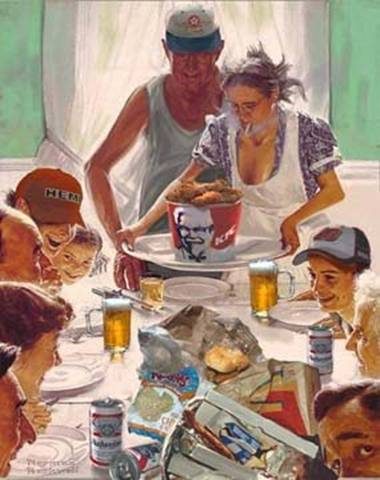
When Norman Rockwell painted his famous painting "Thanksgiving" showing a happy reunion of his own family on Thanksgiving Day over seventy years ago the traditional American family still existed - more as an idea or ideal in many people's minds than as reality. The happiness of the family gathering seems exaggerated to an extent that the painting appears fake, even phony.


Today Rockwell's notion of a typical American family seems even more out of touch with reality. It is almost a provokation considering the social and cultural changes the US has seen over the last decades, not to mention the recent financial crisis that has hit many families hard. This makes the painting an easy target for satire. How does the other half, the non-traditional families, the families who struggle to make a living celebrate Thanksgiving? Here are two descriptions of alternative Thankgiving celebrations we wrote based on parodies of Rockwell's painting:


My Thanksgiving dinner

This Thanksgiving is the first time I’ve been home since I got a scholarship and became the first member of my family to ever go to college. It’s nice to see everyone but it’s not quite the homecoming I imagined. I had expected that everyone would have changed, but EVERYTHING is the same. Jeb is still absolutely convinced he’ll be a NASCAR-driver even though there is no way he’ll get a car anytime soon. Marshall somehow found a Chevy pick-up truck for 200$ and insists on wearing a stupid hat to let everyone know about it. Little Marlene has big dreams but I’m not sure she’ll stay in school long enough. Uncle Jimmy swore he had stopped drinking and yet there are now three Budweiser cans on the table and four more under it. It’s also uncle Trevor’s first Thanksgiving since he got out of jail. Everyone keeps telling him to stop boozing, but it doesn’t seem to be working. Mom and dad seem to be happy enough. Dad obviously didn’t bother dressing up and mom kind of forgot to cook.


My Thanksgiving

Daddy and Carlos have done a great job this year. I’m looking up to Rodrigo holding the camera while all of my adopted brothers are waiting for Carlos to put down the turkey. A year ago, Daddy and Carlos got married. It was a beautiful day in NYC. Today’s a very special day since it’s not only Thanksgiving, it's also daddy and Carlos’ anniversary. The wine tastes divine and the jello is delicious. After a wonderful meal our family had a sing-along in our living room and daddy and Carlos then asked us for a game of twister. Of course we couldn't resist their offer, so we spent the rest of our day doing just that. The best thing about my family is that nobody’s afraid to be just who they are. Daddy and Carlos will always be there for each other, for everyone of us no matter what. Nothing can tear us apart!


Thursday, 14 August 2014

American Beauty - what we have to say about this movie


This is what we have to say about the movie American Beauty. (You can find the script of the movie here.)


American Beauty „Images“


Having an image is a well-known topic in our society. People often show different sides of their characters in different situations. It makes a difference whether we are with our family, at school, at work, with our friends, with strangers, in public or alone. The movie “American Beauty” gives us a very good example for this. We chose three characters whose different images and behaviours we’d like to present you.
Our first character is Carolyn. From the outside she seems to be a happy and successful career woman. She always acts cheerfully and nicely when she’s in public. Carolyn is always dressed up. Her life seems perfect but we learn that this is all fake. Carolyn works as an estate-agent. She says about her job: “My business is selling an image and part of my job is to live that image”. This shows us how much Carolyn cares about appearances and how much she wants to show everyone how perfect her life is, although the opposite of that represents the way she’s really feeling. She has problems with her family, she is an insecure person who tries to act strong, she is unhappy and sometimes seems quite hysteric. In the film we see this in the scene where she fails to sell a house. She closes the curtains because she doesn’t want anyone to know that she’s frustrated, has weaknesses and is insecure. We witness the moment when the facade crumbles. We see what she looks like on the inside. We see her in a moment of weakness, trying to calm down. But then she wipes off her tears, walks out of the room with a proud impression on her face as if nothing bad had happened. The facade is built up again. The cinemathographic language emphasizes this. The camera zooms in on Carolyn’s face while she cried desperately. Now she lets down her facade and we can see who she truly is. The spectator gains insight into her inmost and thus feels closer to her.
Our second person is Ricky’s father Frank. During the movie he comes off as a very authoritarian, severe and even brutal person. He believes in extreme discipline and beats Ricky when he makes a mistake or is insubordinate in any way. Frank appears to be quite homophobic. In one scene of the movie a gay couple comes to visit him because they’re his new neighbours. Afterwards we see him talking to Ricky in the car about these shameless “faggots”. Later in the movie he yells at Ricky and beats him because he thinks his son is gay as well. But in the end we find out that Frank himself is gay because he kisses Lester. So he just hated homosexuals so much because he was ashamed of being gay himself and he put that façade on so that no one would find out his secret. He also isn’t as strong as you might think at the beginning. From the moment Ricky leaves he’s almost constantly crying because he’s so disoriented and embarrassed. In the end he shoots Lester because he now found out his well-hidden secret and he’s probably scared that Lester could tell someone. He kills him to be able to keep up his image of a very “male” and disciplined person.
Angela Hayes is known as the popular girl who has a lot of self-confidence. She often tries to be the centre of attention by showing off how mature and desirable she is. During the movie you can often hear her say that she never wants to become ordinary. But it is clear that all of her actions and her emotions are not real. She wears a mask. All the time it’s just some kind of façade. In the movie you realise this only towards the end when Ricky tells her that he thinks that she isn’t special at all. In this scene she starts getting frustrated and yells at Ricky and Jane. After both are gone you can see her sitting on the stairs being depressed and crying. There’s no sign of the proud and self-regarding woman anymore.
The way this scene is shot emphasizes this. In this part of the movie she is being filmed from a distance. At first you can’t see her very well because she is a bit hidden behind the stair-rail. The director probably wanted her to seem very small, weak and insecure. This scene demonstrates how she’s really feeling. It makes us realise that not everything is what it seems to be. She really was wearing a mask to make sure that nobody finds out what she is truly thinking and how insecure she actually is.
Angela is a typical example of a teenager. Teenagers often struggle with inferiority complexes. Often students try to fake an image to get attention and become popular because this gives them the feeling of being accepted. This phenomenon is universal and you cannot only find it in America or in Basel. But there are also differences when it comes to having an image between what is shown in the movie and what we experience in Basel. Having an image is something that can be found all over the world. But the types of images change depending on their social and cultural environment. One example for this are neighbours. In “American Beauty” they are always overly friendly as seen when the gay couple goes over to Ricky’s family to hand over a welcome gift. In Basel no one would ever do that and people here aren’t always overly friendly to everyone at all times. People would rather show respect than excessive friendliness towards strangers. We think having an image is unavoidable in our society although this is sad. It’s also a shame because then you aren’t able to really get to know them which means that you miss a lot of great chances of making friends. (P.U., N.H., A.P.)


American Beauty -The aspect of beauty


When we first heard that we were going to have to discuss an aspect of American Beauty, we instantly thought about beauty. It`s in the name of the movie after all. There always have and always will be thousands of definitions of beauty and this movie is no different, each character has his or her own sense of beauty. The interesting thing is that these notions clash with one another and that they are so different for a group of people who interact with each other on a daily basis (more or less).
Let`s start with Lester, the main character. He`s sick of his boring, suburban, seemingly perfect life and finds beauty in the past, beauty in youth. That's probably why he choses to quit his job, smokes pot, starts to fantasise about the 16-year-old Angela (who sees herself as the perfect American beauty) and works out to his old rock music in order to impress her. His acts of “rebellion” towards his wife Carolyn also fit into this picture of beauty. 
Next is Carolyn, who sees wealth and perfection as beauty. She's totally focused on her job, her material wealth and projecting a picture of perfection onto her neighbours. Keeping up her rose garden is a symbol of her keeping up her charade of a wealthy, perfect life. 
Jane on the other hand, who's described as a “typical teenager” by her father, has another very different idea of beauty: confidence. For her, the thing she can't achieve herself is the most beautiful and that's also the reason she's attracted to Ricky, who is very confident and knows what he wants. She is very insecure and is trying to ignore the fact that She's only being used by her friend Angela so she can feel better about herself (said by Ricky in the movie). With Ricky by her side she finds her own sense of confidence and with that, beauty. We see this at the end of the movie, when Jane talks back to Angela when she's called a freak for wanting to join Ricky when he wants to leave for New York.
Ricky himself has the most interesting sense of beauty, at least according to us. He finds beauty in everything. It's a protection mechanism due to his family issues,  but it still is something that we remember best after watching this movie. Him filming a plastic bag for 15 minutes, describing it as “dancing with him” or staring fascinated at dead Lester, he truly does have a weird, but wonderful view on what he finds beautiful.
At the end of the movie, Lester changes his view of beauty to something more like Ricky's view: “ I guess I could be pretty pissed off about what happened to me… but it's hard to stay mad, when there's so much beauty in the world. Sometimes I feel like I'm seeing it all at once, and it's too much, my heart fills up like a balloon that's about to burst…”  In his last narrative, Lester finally realizes beauty as a whole, a notion that we could only see with Ricky in the movie. This might be a realization, but we can also imagine it's him calming down before he dies.
Beauty is universal, so of course it's something we discuss here in Basel, too.  Beauty is subjective; everyone has his or her own definition of it here, too. We want to compare our beauty standards here in Basel to the ones we've seen in the movie, a portrayal of an American suburb. Youth has been a standard in the cosmetic industry for awhile now and the reason for that may not only be memories and good times attributed to the image of youth (as done so in American Beauty in Lester's case), it's also the physical aspects. Materialism is probably the main parallel we can see to this movie when we compare it to here.  People here do seem a little focused on it; some conversations are mainly about it. But does this mean that it's a beauty standard? Maybe it's not as a physical one, (although brand clothing is popular) but it definitely is a mental one around here. We think that it might even be influencing ourselves, even though we admit to it reluctantly. In conclusion, we think that the media heavily influences beauty standards and that most people here cannot make up their own minds about what beauty is since there are so many ways of seeing beauty and not enough time to actually think about it. This may be a little different from the movie, but we think that it's not that far away from what we've seen. /M.P./ M.A./ S.H./.


Identity:  Angela Hayes


While reflecting on the movie we saw that one subject, which was often referred to, was how we develop an identity. This is a question that Angela Hayes is dealing with in the movie. She is creating this image of herself as a very unordinary and confident young woman. She enjoys every bit of attention she gets and likes to talk to her schoolmates about her made-up affairs with older men. She doesn’t even mind being called a “slut” because that’s a part of the image she is trying to create. In the movie she tells Jane: “I don’t think that there’s anything worse than being ordinary.” We believe this is the reason why she is trying so hard to be different and special. She would rather be a “slut” than an ordinary suburban chick.
Later on in the movie we figured out that actually she hasn’t had any affairs and is still a virgin. At this point we realize that she isn’t as confident and perfect as she wants everyone to believe. She gets into a fight with Jane because she notices that Jane is a lot more unordinary than she is. Ricky’s words bring Angela back to reality because he clarifies that he was able to recognize her real identity. He says, “[…] you’re boring, and you’re totally ordinary and you know it. […] She’s [Jane] not your friend, she’s just someone you use to feel better about yourself.“ And we think he’s right. Angela uses Jane to gain more confidence about herself, knowing Jane is naive enough to believe everything she says and does. Jane admires Angela and wishes to be more like her.
The fact that Angela smokes shows us that there is a restlessness inside of her and that she has the need to prove herself to others. Angela, not knowing who she is supposed to be, wishes to be grown up already, unlike Lester who wishes to be young like her again.
In the first scene Angela appears, they are on the school basketball court. Lester is totally paralyzed by her beauty. The camera now focuses on Lester’s perspective. Suddenly it seems as if only he and Angela were in the room. She is in the center of the spotlight and her movements are shown in slow motion. In this first depiction, it seems as if we already know her role in the movie because her appearance in this scene shows us perfectly the image she is trying to create. We, as the spectators, assume that Angela is the “American Beauty”. This scene is the beginning of change for Lester. Because of her he begins the new chapter of his life. This makes her character a key role in the movie.
Now we want to compare Angela’s behavior with the one of other teenagers like us. In our view Angela’s actions are comprehensible for a girl her age. In this stage of life most people try to find their identity, try to figure out who they want to be and what they want to do in their future. For some this is easier and others like Angela have a harder time doing so. She has more difficulties finding an identity. That's why we consider her to be so ordinary. We all have to go through this stage and find our own personality. This process, no matter whether this happens in Basel or California, takes place the same way. In our time lots of people lack self-confidence and don't feel confortable with the person they are. So basically what they do is putting on a mask and acting as if they were different, they hide their real face, try to get the attention of the others they want to be like. Angela wants to be a model and in order to become one she thinks she has to create this specific image. We assume that in America the pressure of the media is higher than here in Basel, because it’s local. This has a direct influence on how people in the US want to appear in public. They feel obliged to maintain a certain image. We think that the desire to be perfect and to have no flaws is more common in the US.
So at the end of our analysis of Angela’s behavior we come to the conclusion that she is just like us, and in fact now we feel as if we knew her and understood her actions better. Trying to search for one’s own identity is normal, it’s perfectly human and everyone has to go through this stage in life. All we can hope for is to be surrounded by people who care about us. We wish the character of Angela could have had that.  (SG, MS, AP, JG) 
 

Being a teenager


To become an adult means passing a difficult time with yourself, your relatives, your friends, your body, your hormones. You go through many different experiences. Some of them are bad, others are great This way you try to find your own way of life, one that agrees with your personality.
To illustrate this we would like to discuss the main teenage characters from the movie „American Beauty“.
Jane, the daughter oft he main character, Ricky, a schoolmate, and Angela, the lascivious friend of Jane's.
Jane Burnham is a typical 15-year-old teenager going through puberty. She represents a timid shy girl who is a little bit depressed and anxious. Jane is also really insecure and is jealous of her mate Angela. But Angela is not caring about Jane always being less important than her. And like almost every teenager she is angry with her parents, mostly with her father because he never gives her a lot of attention. Jane represents a typical teenager, even though she dresses like a goth.
In the movie there are lot of different camera shots, but the most important shows her with her boyfriend at the beginning and end of the movie.
At the beginning she is always filmed from above, in order to make her look even more insecure.
But in the end this changes; she is filmed from below, because she is telling Angela that she doesn’t want to be in the background anymore.
Ricky Fitts not only has to deal with own issues, he must also deal with family problems. Sometimes he can find the silence to just observe irrelevant things, which gives him possibilities to explore simple wisdoms about life: “Sometimes there’s so much beauty in the world, I feel like I can’t take it, and my heart is just going to cave in.” He can’t handle the deep thoughts because he’s too young yet, but at the same time it helps him to overcome the discipline and structure, which is always demanded in his fathers presence. The way the camera focus on this irrerlevant plastic bag dancing in the wind shows the different directions a teenager could take in life and that there is no reason to hit the aim directly.
Ricky has to learn how to accept unpleasant or painful things. He begins to understand his mother and learns to accept her disease. He also learns to deal with his father's violence, even when the accusations are wrong. That puberty isn’t new for Ricky makes it possible for him to feel with Jane, better than her parents do and finally they can distract each other from the pressure of having to deal with many tough situations in life.
Another character of the movie named Angela Hayes has a strong influence on Jane. Angela’s pretty much a stereotypical all-American teenager. She’s blond, has blue eyes and most people find her attractive. All in all, the first impressions of her, the way she appears, might be really remarkable and she seems to be very self-confident, but at a closer look it becomes clear that she has some serious issues. For instance, she probably suffers form an Inferiority complex. In many scenes in the movie she explicitly pretends to have had sex many times with many guys, even tough she’s still a virgin. By doing this she wants to attract attention because she feels lonely. There’s only Jane, who’s on her side. At the end, even this friendship ends. We don’t know much about her personal background, for instance what her parents are like, or if she has experienced any events in her lifetime, which caused a psychological trauma and could explain her behaviour. In general, this character is very superficial and apart from her lascivious behaviour, not much is known about her in comparison to Jane and Ricky.
While we were watching the movie we were a little bit astonished because the characters were really exaggerated. But after watching the film we understood why they were like this. The characters were just showing what puberty is like and how it feels, but not only for them but for the people who were living with them. What we really liked about the scenes with the teenagers and their families was that we could see everything from the perspective of the adults. This was very spectacular because this was a whole knew experience for us.
It was also interesting for us to see that the characters were so typical, one was lonely, the other one was the beautiful and the third teenager was the thinker. This reminded us of our classifications of the people in the school and how silly this was.
There were some scenes which reminded us of our own puberty. One scene was the scene in the kitchen when they were disputing, this reminded us of our conversations with our parents and the long discussions about some unnecessary things. What we also realized was that all the teenagers wanted to break out of their conventional lives and have their own rules.
In the movie all this was easy to see and understand because things are exaggerated. But we hope that we weren't as extreme and exhausting as they.


Social pressure 


Norms influence our behaviour. Norms affect our lives because they help build up a social pressure on all of us. We adapt to the expectations of the environment because we are scared not to be accepted within the community. We accept not to be the persons we truly are just to be a part of society that’s based on norms someone else invented. For one of the main characters in the film “American Beauty”, named Lester Burnham, this phenomenon has the effect that for 20 years he lives a life he doesn’t want to live. We would like to discuss where the pressure influencing him comes from.
There are several persons in the film that have expectations about Lester. Right at the beginning his daughter says in a straightforward mannerthat her father is a “lame-o” and that “someone really should put him out of his misery.” This shows us already that Lester didn’t fulfil his role as a good family father. His wife Carolyn seems to be a very successful businesswoman. But things are not as they seem to be. She is not really good at her job and because of that she has to be really dominant at home in order to build up a better self-esteem and reach her own expectations of a good life. At home Lester is absolutely subordinate to his wife. That pulls him down and makes him think that he is absolutely ordinary and not successful. So he has a very low self-esteem. We can see this in the scene where Lester and Carolyn go to Carolyn’s business party together. In this scene we can clearly see that it is Carolyn who actually wants to go there and Lester is only a protagonist to level up the image of his wife. When Buddy King, a business partner of Carolyn’s doesn’t remember him Lester just says: “Oh, we met each other already actually at this Christmas thing. But it doesn’t matter, I wouldn’t remember me either.”
But who is to blame? Our society measures success by the the amount of money on a person’s bank account rather than by the happiness he or she feels and gives to other people.  Happiness in our society is measured by the things a person can afford. Something is wrong. Why does a person even work that hard in a job she/he does not like? The answer: the superficial expectations from families and people surrounding us. Our materialistic world ruled by smartphones destroys the true values of life and replaces them step by step. That´s why our most important duty at the moment is to keep the knowledge of the true happiness of live alive despite of all the pressure and the disapproval that we have to face.
If we compare this to our own lives, we can see a lot of parallels: It may not be as extreme in our case, but almost everyone puts social pressure on us. From our parents that “force” us to be successful, because otherwise they would be disappointed, to our so-called “colleagues” that want us to adapt to these norms to be accepted. Social pressure is daily business. We grew up with it and this pressure has become normal. But that’s our problem… Many people can’t handle this pressure – the result can be, but doesn’t have to, an exaggerated reaction, such as introverted personality, self-injuring or maybe even suicide.
In “American Beauty” we see a typical form of midlife-crisis. This is also a very common problem of the middle-aged adult men or women in our society.  It is very hard to define how many people suffer from this problem, but it is said that
about 5 percent of the males between 30 and 50 years have had a midlife-crisis. About 0.01 percent of the Swiss people commit suicide (2011). Even though this is a very low rate there are still 70’000 people in Switzerland that kill themselves during their lifetime. That is how far social pressure can go! This makes it a deadly problem that many people underestimate because we mostly notice when it’s too late. (JL, MM, NR, GZ)


This is my neighbourhood, this is my life 


The movie “American Beauty”, which was produced in 1999, plays in a typical American suburb. The film is about a family in a typical middle-class neighbourhood. It shows many conflicts that can occur in such an environment. Now we would like to discuss how this kind of suburb affects the different family issues that are addressed in the movie.
The district in which the Burnham’s and their neighbours live is called Anytown. Everything looks the same, and we think that already the name tells us that the story could take place in “any town” and that there are a lot of places like this one. The filmmakers didn’t want to present a unique town. Instead they wanted to show that the place they have chosen for the movie is inspired by the everyday lives of many American middle class families.

The cinematographic language underlines the feeling of a normal, everyday life. At the beginning of the movie they show the whole suburb and afterwards they zoom in until we only see the house of the Burnham’s. This technique is also applied at the end of the movie, but this time the other way around. When we have zoomed out so that we can see the whole suburb, we can also see the perfect tree lined streets. They underline the illusion of a perfect and traditional life.
Another relevant issue related to suburban life, which comes up in the movie, is privacy or rather the lack thereof. The big windows and the backyards with the tiny fences make it easier for the neighbours to observe each other. So the neighbours are already tempted to watch the families next door. A good example for this is the scene where Ricky films Jane while she is having a fight with her dad in the kitchen. Another example is the moment when Carolyn is working in the garden and gets a compliment from her neighbour for her beautiful roses.
In the movie the issue of having a perfect image appears a lot. In Carolyn’s words: “In order to be successful, one must project an image of success”. Or to rephrase what Carolyn said, it is important to keep the illusion of a perfect life in front of the others although the truth might be different.
In general we think that people in Basel and the surrounding suburbs appear to be more tolerant towards the problems of other people. It isn’t that important to have a perfect image. This might be because in our city there is a bigger diversity of cultures and lifestyles. For example there are a lot of immigrants, young people and older people as well. Therefore we don’t have such an imagination of a perfect family and a perfect life. Even though you aren’t perfect the Swiss society accepts you as you are.
Another aspect when it comes to comparing American and Swiss suburbs is that here the people are more anonymous, but not in a negative way. We assume that in Switzerland, and especially in Basel, neighbours are friends rather than rivals. We share joy and great experiences instead of being jealous of one another.
Families in Basel are also more focused on their individual lives and their well-being than on observing others. If our neighbours have guests, for example, we won’t be starring at them all the time or comparing their social life to ours.
But we also found some similarities in the way Swiss and American suburbs work: the majority of the suburban population consists of middle-class families and the relations with the neighbours is not inessential.

In conclusion we can say that life in Basel and its suburbs is more relaxed and that people focus more on their own lives. We think we have more privacy in Swiss than in American suburbs. (S.W. Z.K. V.B.)


Father-Son Relationship between Ricky and Frank Fitts


From the beginning Colonel Fitts seems to be a very secretive, organized and a dominant personality. He, his wife and Ricky move in next door to the Burnhams at the start of the movie. But although it seems pretty normal in the first scene, the father-son relationship in American Beauty is far from typical. It is littered with emotional and physical abuse. Colonel Fitts enforces his extreme discipline that was instilled in him by the army on his son. He also has a big fear of his son being a homosexual and even takes it as far as saying, “I’d rather you be dead than be a faggot”. He has an extreme overreaction when he thinks that Ricky could possibly be a homosexual. He kicks him out of the house and tells him he never wants to see him again. Physical abuse in form of beating is often used by the Colonel to show Ricky his boundaries. But really it seems like Frank is trying to hide his own problems and insecurities by portraying a tough army veteran. But it’s not only Frank’s fault. Ricky knows that his fathers’ psychological wounds of war are still fresh and abuses all the negative traits of his father for his own gain. Frank, although he obsessively tries to control Ricky, does it more out of love than just to harass Ricky.

The origin of the entire problem is like already mentioned most likely the mental problem that Colonel Fitts is facing since he retired from the military and the inner conflict of being a closeted homosexual. But in the movie Ricky mentioned that his father put him in a mental institute for possessing the drug marijuana. This and his hate against homosexual people lead to the assumption that Frank probably grew up under very conservative conditions or that he had some sort of a scaring event during his childhood or adolescence. Ricky’s father is also in deep denial about what Ricky does in his free time and where he gets his money from. He is so afraid of the idea that Ricky is involved with drugs again that he completely blocks out the fact that Ricky has way more money and camera equipment than any normal teenager could possibly afford. Ricky is very aware of the fact that his father believes whatever he wants to believe and uses it to his advantage. This becomes clear in a conversation where Ricky says to Jane: “My dad thinks I paid for all this with catering jobs. Never underestimate the power of denial.”

To summarise, the father-son relationship between Ricky and colonel Fitts is very confrontational. Even though Frank claims he only wants the best for his son and is imposing his strict form of discipline on him because he loves him, you get the impression he derives some sort of satisfaction out of doing things like regularly drug testing his son or even physically assaulting him. You never get the impression that they are on the same side. It always seems to be the same thing, Frank sets new boundaries and Ricky finds new ways around them. Ricky escapes this cycle when his relationship with his father completely breaks down, over suspicions from his extremely homophobic father, that he might be gay. He gets kicked out of the house and leaves for New York, most likely never to see his father again.

We think that this relationship in the movie demonstrates some very important issues. It shows that highly confrontational relationships between parents and children don’t work. If a parent cannot come to an understanding with their child and starts to impose strict rules upon them, the child will start to resent them and either find more ways to antagonize their parents or simply find any way possible around the rules. It also demonstrates how intolerant and unforgiving parents can be towards their own children. The intolerance of certain parents towards things such as drug use and homosexuality, the things mainly shown in the movie, are a very real thing. It happens all over the world, including here in Switzerland and it is sad to think that this could be happening very close to us at any time. Some think their children are sick if their children come to them with things such as these and they can be highly judgemental instead of supportive. Sadly many people have been kicked out of their homes or have been completely disowned by their parents for having different views than their parents. We thought this real life video seemed very relevant to some of the aspects of the movie: 

https://www.youtube.com/watch?v=1df_i26wh-w
This shows that these kind of issues really do exist and we think that the movie does a very good job of raising awareness for these kind of issues. (M.C, M.H, L.B, O.M)

Different cultures, different mentalities, values and lifestyles II (working title)

Summary and comment to be handed in by Friday, 26th of September

Different cultures, different mentalities, values and lifestyles III (working title)

Summary and comment to be handed in by Friday, 24th of October

Different cultures, different mentalities, values and lifestyles IV (working title)

Summary of article and comment to be handed in by Friday, 7th of November

Different cultures, different mentalities, values and lifestyles V (working title)


Text on "My Son the Fanatic" (Hanif Kureishi) to be handed in by Friday, 28th of November